
Chapel Hill City Directory Collections
The verified online record is narrow. Digital NC has a Hill's Chapel Hill volume for 1959 and a Hill's volume for 1961 that includes Carrboro. Those are useful, dated snapshots, not proof of an annual run. The Chapel Hill historic-district report says directories do not exist for the town before the 1950s, while the inspected sources do not establish which years from the 1950s onward survive. The Library of Congress also cautions that directory coverage and arrangement vary. Keep the edition, page, and repository with every transcription.
| Collection | Years | Where Held | Access |
|---|---|---|---|
| Hill's Chapel Hill | 1959 | Digital NC | Online PDF |
| Hill's Chapel Hill, including Carrboro | 1961 | Digital NC | Online PDF |
| Genealogy and newspaper finding aids | Varies by resource | Chapel Hill Public Library | Online and in-library access varies |
| Orange County local-history holdings | Varies by holding | Rebecca B. Wall Collection, Hillsborough | Ask the collection staff |
The Library of Congress directory guide describes the usual alphabetical personal and professional arrangement, but a local volume may omit people, addresses, telephone numbers, or whole years. Treat an absent name as an unanswered question, not a final conclusion.
Note: The confirmed 1959 and 1961 volumes are examples, not proof of a complete local publication sequence.
Chapel Hill Library Directory Shelf
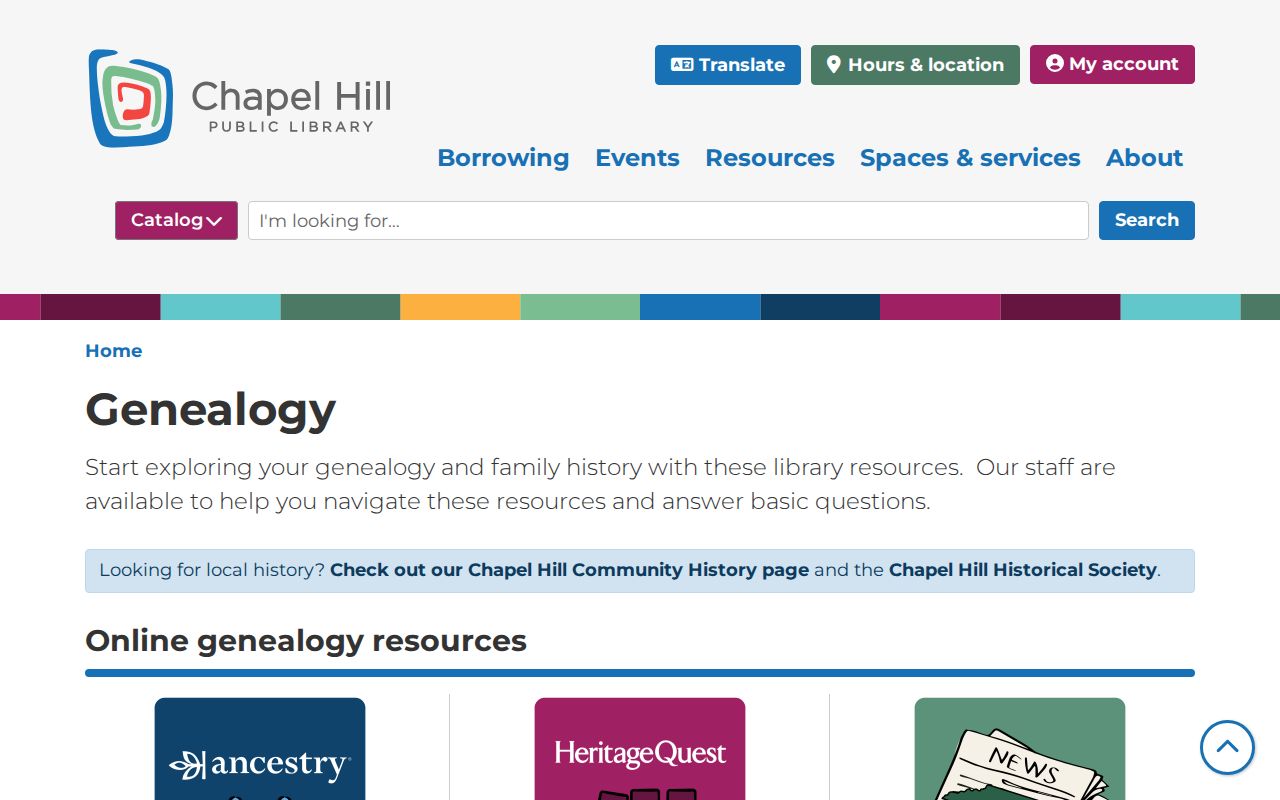
The Chapel Hill Public Library genealogy resources bring together several companions for dated listings: HeritageQuest, historical North Carolina newspapers, a Newspapers.com North Carolina collection, NC Live, community-history links, and Chapel Hill Weekly material through the Library of Congress. Ancestry Library Edition is listed for library Wi-Fi. Access conditions can differ by database, so a library computer, card, or Wi-Fi connection may be needed for a particular search.
The municipal branch is at 100 Library Drive in Chapel Hill. Its listed hours are Sunday 10–6, Monday through Thursday 10–8, and Friday through Saturday 10–6. Call 919-968-2777 before making a special research trip, since database access and hours can change.
The library's genealogy page identifies the local research tools available for Chapel Hill directory work.
Use the library source as a path to a dated newspaper notice or reference work that can corroborate a printed entry.
Chapel Hill Digital Directories
Digital NC's 1959 Hill's Chapel Hill volume and the 1961 Hill's Chapel Hill and Carrboro volume are the confirmed digitized examples. The 1961 title matters: a Carrboro listing should not be silently reclassified as a Chapel Hill town residence. Save the printed spelling and page number, even when a modern map uses a different postal or municipal context.
Search surname variants, initials, and an address where one is known. If the first search fails, browse the alphabetical section and check the volume's own abbreviations. A handwritten research note should label the result as historical and state the publication year.
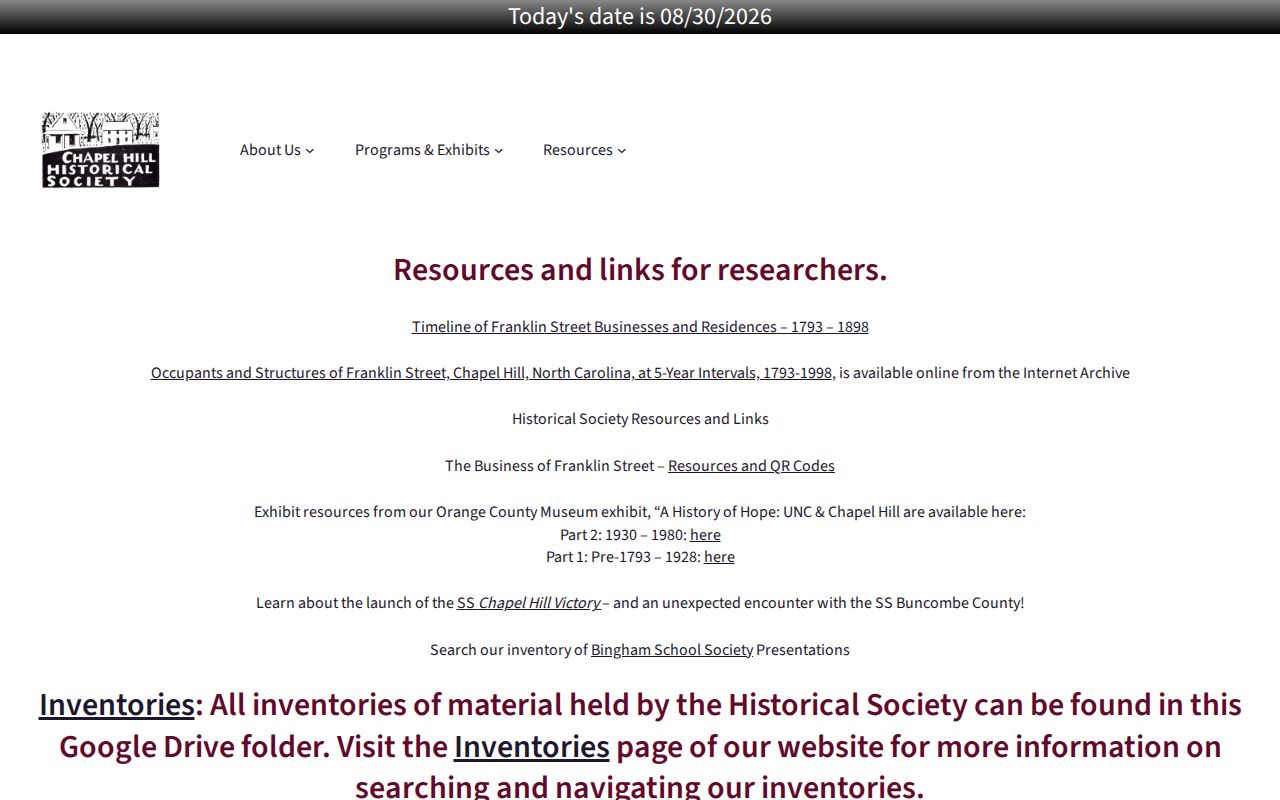
The Chapel Hill Historical Society resources page points researchers to related Digital NC material, yearbooks, maps, architectural drawings, and Franklin Street occupancy research.
Those companion collections can help distinguish two people with the same name without treating any one result as enough by itself.
Chapel Hill Directory Context
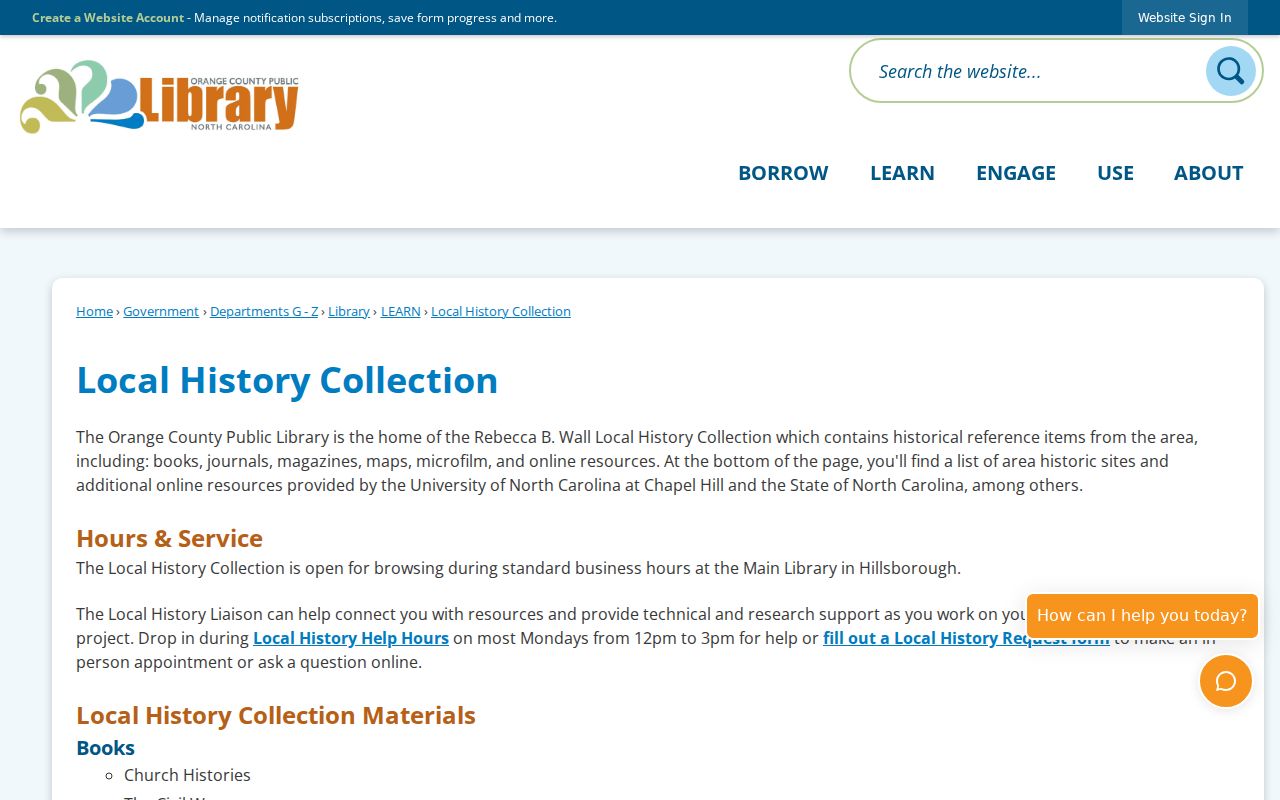
When an online volume does not answer the question, the Orange County Local History Collection supplies a broader research shelf. The Rebecca B. Wall collection at the Main Library in Hillsborough lists books about local families and churches, county newspapers on microfilm from 1820 to the present, court minutes from 1752–1868, deed and will indexes, deed and will records, marriage bonds, and Orange County census material. It also lists HeritageQuest categories that include directories and family genealogy.
Local History Help is listed for most Mondays from noon to 3 p.m. That is a useful fallback when a web search produces only an incomplete scan or an unexplained abbreviation. Ask about the specific surname, street, year, and alternate town name instead of assuming that every reference source contains the same run.
The Orange County collection page describes the local-history holdings and staff-help schedule.
Microfilm newspapers and county indexes can supply a dated second signal when a directory leaves a household relationship unclear.
Reading a Chapel Hill Directory Entry
Read the line as a compact historical record. The source may print a surname, given name or initials, spouse or household notation, street address, telephone number, profession or organization, and a cross-reference. It may also use short forms such as r or res for residence and h for household. Transcribe first, then consult the key in that same volume. Expanding an abbreviation from memory can change the meaning of the entry.
| Name | Printed surname, given name, or initials; preserve punctuation and spelling. |
|---|---|
| Household clue | Spouse, household, or relationship notation when the volume provides one. |
| Address | Street number, street name, room or apartment information, and postal place as printed. |
| Organization clue | A profession, business, or affiliation that may distinguish a same-named person. |
| Cross-reference | A pointer to another spelling, business entry, or address section. |
- Criss-cross directory
- An address-first arrangement that groups entries by street and number when a volume includes it.
- Householder index
- An index organized around a household name, useful when a spouse or child has a different entry.
- Abbreviation key
- The volume's own explanation of initials and short forms, usually near the front; capture it before interpreting entries.
Note: A printed address is a dated historical fact, not a statement about anyone's present location.
Chapel Hill Directory Matching
A convincing match needs two independent signals where possible. Pair the name with an uncommon address, a middle initial, a dated institution or organization, a parcel instrument, a family relationship, or an obituary detail. Keep candidates with the same name separate until the added record actually connects them. A property owner, court party, or campus affiliate does not automatically prove a town household.
University records need special care. UNC's charter dates to 1789, its cornerstone to 1793, and the University opened in 1795. Chapel Hill developed beside it, but University and town materials are held by different custodians. A student, staff, or faculty reference can support an institutional connection without proving a Chapel Hill municipal residence.
Chapel Hill Directory Timeline
The documented points below frame what the available collections can and cannot show. They are not a claim of continuous publication.
- 1789–1795: UNC was chartered, built around its 1793 cornerstone, and opened, shaping the town's separate University and municipal record trails.
- 1819: Chapel Hill's incorporation year, corrected in town minutes from an earlier displayed date, anchors the town chronology.
- Before the 1950s: The historic-district report says Chapel Hill city directories do not exist for this earlier period.
- 1959: A Hill's Chapel Hill volume is verified in Digital NC.
- 1961: A Hill's volume covering Chapel Hill and Carrboro is verified in Digital NC.
Between those points, town minutes, newspapers, maps, tax records, and archive finding aids may provide the needed dated context. Do not turn that mixed evidence into an invented annual sequence.
Trace Chapel Hill Directory Households
Following a household works best as a documented sequence, not a leap from one familiar surname to another. Start with the edition that contains a known name or street, record the entry exactly, and then look for the next available verified edition. Census material is a separate dated source, so use it to frame a household at its own enumeration date rather than to fill every missing directory year.
- Find the earliest verified entry and record its year, page, spelling, address, and abbreviations.
- Check the next available directory edition for a move, changed initials, household notation, or organization.
- Compare the printed address with a dated newspaper notice, town minute, cemetery record, parcel source, or census image.
- Mark the result as exact, likely, unresolved same-name, or not a match, with the reason for that choice.
- Keep a source date beside every address, especially where a street, campus location, or postal label changed over time.
A disappearance can mean a move, death, omission, or a changed listing style. It does not identify the cause by itself. For a present-day street and parcel workflow, use the Chapel Hill street directory after preserving the historical date.
Chapel Hill Maps Beyond Directories
NCSU's Sanborn list confirms five Chapel Hill maps covering 1911–1949, but the inspected list did not establish the individual edition years or complete-sheet coverage. A Sanborn sheet can show a building's materials, use, stories, streets, and lot relationships. It is a historical fire-insurance map, not a record of who occupied a building.
Pair a map with a dated directory entry, tax or deed material, and a newspaper or minute when the question concerns a structure. The historic-district report used Sanborn maps, tax records, architecture, and related research because pre-1950s directory coverage was absent. Historic street geometry, neighboring structures, and parcel lines can be more reliable than assuming a modern number always matches an older one.
Chapel Hill Directory Limits
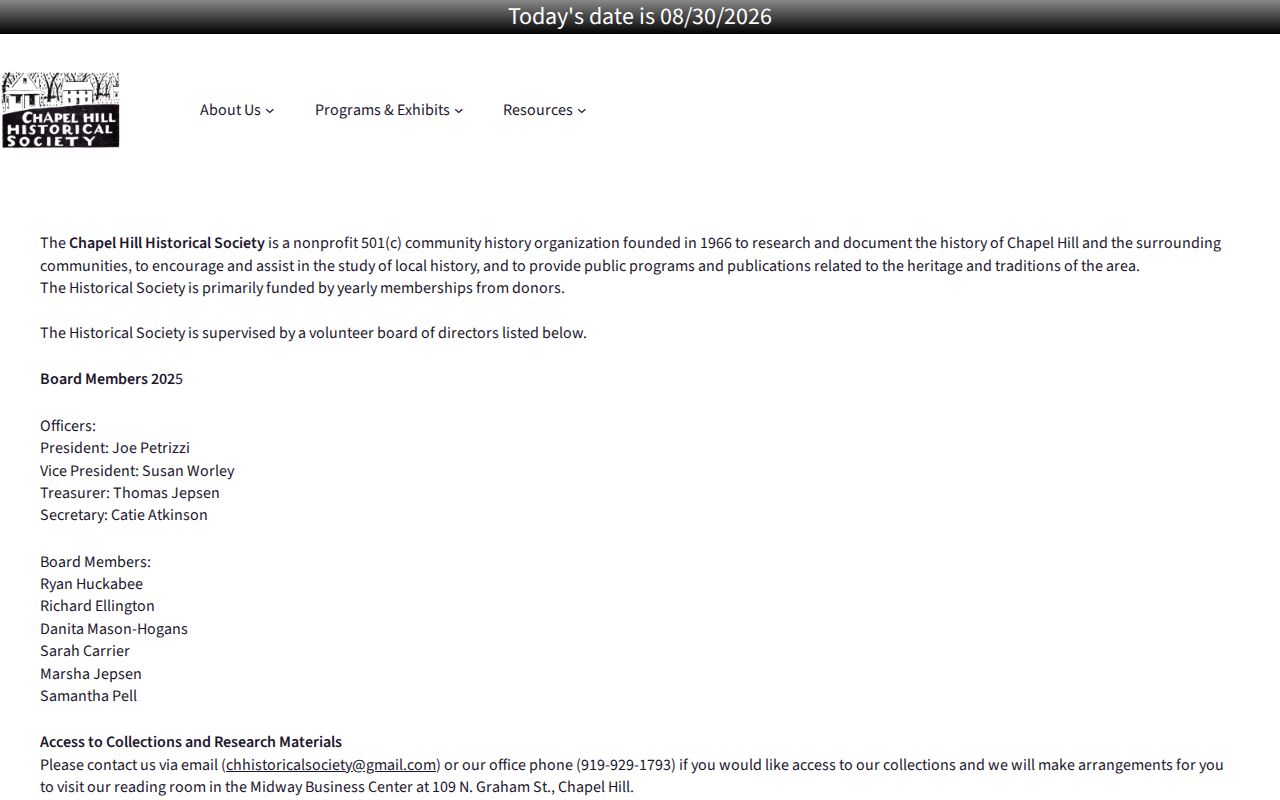
The Chapel Hill Historical Society, founded in 1966, maintains a collection and reference reading room at Midway Business Center, 109 N Graham Street, Suites 102/104. Access is arranged by email or phone at 919-929-1793. Its materials and linked resources include photographs, maps, architectural drawings, yearbooks, ledgers, newsletters, and collection inventories, all useful for testing a dated entry against its local setting.
The Historical Society access information explains how to arrange reference use.
These holdings complement the online volumes, but neither a missing scan nor a missing marker proves that a household or building was absent from Chapel Hill history.
Note: Keep sensitive details minimal and use archival materials for family history, local history, or a narrowly defined record question.